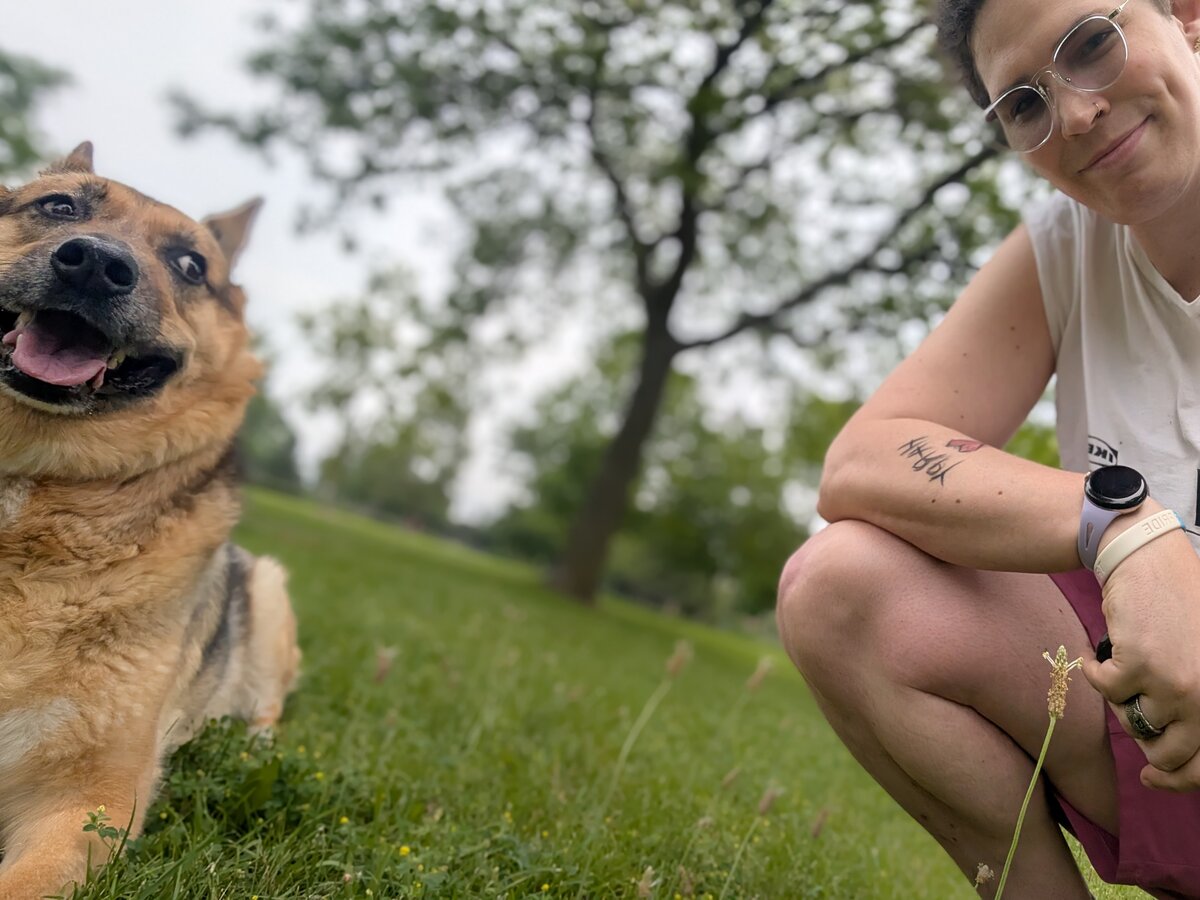
Fluent in Dog 🐾
Every dog I've ever met has understood something about me faster than most people do, and I've understood something back. That's not a metaphor and it isn't a party trick. It's the clearest, most reliable relationship I have with anything that isn't code, or Harley herself. This page is about why.
The gift I trust
I've worked as a paid dog walker, among the fairly wild spread of jobs I've held, but that's not where this comes from. It's the other way around: I took that job because I already had this, and wanted to see what it looked like as a discipline instead of just something I could do. This has always been a hobby and a passion for me, not a career, and I want to be precise about that: I'm not a professional trainer or a credentialed behaviorist. I'm not sure how to explain the pull of it except to say I trust it completely. Put me in front of a dog nobody else wants to handle and I don't feel dread, I feel curious. I've genuinely never met a dog too challenging for me to work with, and I don't say that to brag. It's closer to a description of what draws me in: the harder the dog, the more interesting the problem, and the more it asks of me instead of just the dog.
The mechanics of it are less mysterious than the instinct makes it sound. Positive reinforcement, always, because fear-based compliance isn't the same thing as trust and I'm not interested in the difference disappearing just because it's convenient. Behaviour adjustment training and desensitization for anything rooted in fear or overstimulation, so the dog gets to choose a different response instead of being flooded into one. And underneath almost everything, the deceptively simple "look" or "watch" game: teach a dog that noticing the scary thing and then checking back in with you is worth more than reacting to it, and you've handed them an entirely different option they didn't know they had.
The part that's actually mine, though, is what I do with my own body before any of that starts. I regulate my own energy and my own expectations first, because a dog reads what I'm carrying into a room a lot faster than it reads a cue word. Anxious energy, rigid expectations, and impatience with how long something is taking all go straight down the leash whether I say a word or not. Getting my own state right before I ask anything of the dog isn't a nice-to-have on top of the training. In my experience it's most of the training.
Harley: the one who tested everything
Harley was severely reactive as a young dog, worse than anything I'd handled before her, and for a while that wasn't a fun challenge, it was genuinely destabilizing. It triggered real anxiety in me, the kind that makes it hard to be the calm, steady presence a reactive dog actually needs from you. There was a stretch where I couldn't be that for her, and my partner at the time had to take the lead in ways I couldn't. I'm not leaving that out. A page about trusting my own gift with dogs isn't honest if it skips the part where that gift hit a wall and someone else had to carry it for a while.
What came after that is the part I'm actually proud of. We worked incredibly hard, both of us. Books, training videos, a genuinely unreasonable number of TikToks, trying something new almost every single day for months, refining what worked and dropping what didn't. Some of it worked immediately. Some of it took repeating for weeks before anything shifted. None of it was a program we followed start to finish, because reactive dogs don't really respond to a program, they respond to consistency, and consistency is just showing up again tomorrow even when yesterday didn't go the way you hoped.
-
Early days
Worse than I'd handled before
Reactions that came in hard and fast, over things I couldn't always predict in time to get ahead of. The instincts I trusted with other dogs weren't landing the same way, and that was its own kind of unsettling.
-
When it got hard
The anxiety got in the way
My own state stopped being steady enough to help her, and my partner at the time stepped in and took the lead for a while where I genuinely couldn't. Not a failure. The right call.
-
The daily work
Books, videos, and trying again
Reading everything we could find, watching trainers break it down frame by frame, testing something new most days, and treating a bad session as information instead of proof it wasn't working.
-
Now
A dog I understand, not a dog I fixed
She's not "cured," because that was never the actual goal. She's a dog I can read, a dog who checks in with me instead of only reacting, and a dog I understand a lot better than I understood myself back when this started.
Kayleigh, Dude, and Riley
Harley is the dog who tested everything I thought I knew, but she's not the only one this shows up with, and not the only one who came to me already carrying something heavy. The other three each taught me something different, and two of them taught it the hard way.
Kayleigh
She'd been beaten for years before I had her, and it showed. She was terrified of men, and that fear came out as aggression more than once, including toward me. I wrote about it on Facebook and Instagram at the time. Living with her is where I learned how much of what looks like a behaviour problem is really just fear with nowhere else to go.
Dude
The dog I had before either of them, and one of the worst cases of animal abuse I've known firsthand, severely reactive because of what had been done to him before he was mine. I wrote about it on Reddit, in r/rage, when it was still raw. He was a gift to me and my family from Brenda, a family friend we've since lost. Rest easy, Brenda. I lost Dude himself a few years back, and I still measure certain kinds of pain against how much that hurt.
Riley
My mom's dog, not mine, so my hand in it is lighter, but I helped raise her from a puppy until I moved away. She's a good girl, stubborn and clingy in the best way, and the same eye applies whenever I'm around her: watch the body language first, ask less than you'd think, and let the dog tell you what's actually going on.
When we had Dude, my mom and I brought in a professional trainer, a woman whose sessions were some of the most genuinely valuable dog-related hours either of us ever spent. I didn't need her to convince me the instinct was real. I needed her to put a professional shape around it, and that's exactly what she did. It's the whole reason I don't think of this as "just a gift" anymore. A gift you never test against someone who actually knows the field is just a story you tell yourself. Getting that professional understanding is what turned it into something I could trust on purpose, not just when it happened to work.
Whose work actually holds up
I have opinions here, and I'll say the unpopular one first: I don't practice the old dominance-based, "be the alpha" style of training that a certain very famous TV show built its whole brand on, and it's not close for me. I've watched clips of people getting bitten because they read a clearly fearful, reactive dog as a dominance problem instead of a scared one, and that isn't a training philosophy having a bad day. It's someone in over their head with an animal who was already telling them, as plainly as a dog can, that they'd misread the entire situation. Fear doesn't respond to being overpowered. It responds to being understood.
The people whose work I actually trust are the ones building from behaviour science instead of mythology. I consider myself more of a dog behaviorist than a trainer in the traditional sense, someone trying to understand the deeper inner workings of why a dog does what it does, not just how to make it stop.
What growing together actually looks like
I'm drawn to the challenging ones on purpose. A dog nobody else wants to take on isn't a burden to me, it's the whole appeal. They push on the parts of me that need pushing, the patience, the self-regulation, the willingness to sit in "this isn't working yet" without deciding it never will. I push back the same way, with consistency instead of force, and somewhere in that trade we both end up better than we started. That's the entire bond, as far as I can tell. Not a trick I perform on a dog. Something we build together, on purpose, one hard day at a time.